The UAE has always moved fast. But 2026 marks a new inflection point in how businesses manage their finances. Artificial intelligence is no longer a buzzword reserved for tech giants — it is now embedded in the daily accounting operations of UAE businesses of every size, from free zone startups to multi-entity enterprises across the GCC.
Simultaneously, the Federal Tax Authority (FTA) is rolling out e-invoicing mandates, tightening corporate tax enforcement, and integrating real-time data systems that connect directly with business accounting platforms. For businesses still relying on spreadsheets or outdated desktop software, the margin for error has effectively disappeared.
This blog explores the key financial compliance and accounting trends reshaping the UAE in 2026 — and why forward-thinking businesses are partnering with expert accounting firms to navigate this new landscape with confidence.
1. E-Invoicing in the UAE: The FTA's Real-Time Compliance Revolution
One of the most significant regulatory shifts of 2026 is the UAE's move toward mandatory e-invoicing under the FTA's digital tax infrastructure. Known as the 5-Corner Model, this framework requires businesses to transmit B2B invoice data to the FTA portal in real time.
What this means in practice: every invoice issued is immediately visible to the FTA. Any discrepancy between your VAT filing and your actual revenue — even small rounding errors — is flagged instantly by the FTA's AI-driven audit tools.
What UAE Businesses Need to Do Now:
- Upgrade accounting systems to FTA-integrated platforms capable of automated e-invoice submission
- Ensure all invoice formats comply with FTA's digital invoicing standards
- Conduct a compliance review of current VAT classification practices
- Partner with an accounting firm experienced in FTA digital compliance
Businesses that prepared early report smoother operations, fewer filing surprises, and significantly reduced penalty risks. Those who have not are facing urgent catch-up pressure.
2. AI-Powered Bookkeeping: From Manual Entry to Intelligent Automation
Across Dubai and the wider UAE, accounting firms and in-house finance teams are deploying AI-powered tools that automate the most time-consuming parts of bookkeeping — transaction categorization, bank reconciliation, invoice processing, and VAT classification.
The results are measurable. UAE logistics firms, retail businesses, and professional services companies using AI-assisted bookkeeping in 2026 report significant reductions in reconciliation time, fewer data entry errors, and real-time cash flow visibility that was simply impossible with traditional methods.
Key Capabilities of AI-Powered Accounting in 2026:
- Automated transaction categorization from bank feeds and payment gateways
- Real-time VAT classification across standard-rated, zero-rated, and exempt transactions
- AI-driven anomaly detection that flags unusual entries before they become compliance issues
- Automated corporate tax provisions with full FTA alignment
- Predictive cash flow forecasting based on historical transaction patterns
Importantly, AI does not replace human expertise — it amplifies it. The most effective approach in 2026 is a hybrid model: AI handles data processing at scale, while qualified accountants review compliance decisions, particularly in complex areas like cross-border VAT treatment and transfer pricing.
3. UAE Corporate Tax in 2026: What Has Changed and What Is Coming Next
The 9% UAE Corporate Tax on net taxable income above AED 375,000 is now an established reality. But 2026 brings additional complexity that businesses must understand:
Key Corporate Tax Developments in 2026:
• Domestic Minimum Top-up Tax (DMTT): Large multinationals are now subject to OECD Pillar Two rules, requiring UAE subsidiaries of global groups to assess their effective tax rate and potentially pay top-up taxes.
• Transfer Pricing Documentation: The FTA is increasing scrutiny on related-party transactions. Businesses must maintain contemporaneous transfer pricing documentation to support their positions.
• Free Zone Qualifying Income: DMCC, DIFC, ADGM, and other free zone businesses must carefully distinguish qualifying from non-qualifying income to maintain 0% tax benefits.
• Tax Group Structures: Businesses with multiple UAE entities are increasingly forming tax groups to optimize their collective tax position — a strategy that requires careful structuring and ongoing compliance management.
The era of treating corporate tax as a year-end afterthought is over. In 2026, tax is a per-transaction reality — and businesses need accounting systems and professional advisors that support continuous compliance, not just annual filings.
4. Cloud Accounting: The New Operational Standard for UAE Businesses
The UAE cloud services market is projected to reach USD 6.30 billion in 2026. Within that growth, cloud accounting platforms have emerged as the operational foundation for businesses that need live financial visibility, anywhere access, and seamless FTA integration.
The shift from legacy desktop accounting systems to cloud-based platforms represents a fundamental change in how financial data moves through a business. Rather than static month-end reports, business owners and finance managers now access live dashboards showing real-time P&L, VAT liability positions, cash balances, and outstanding receivables — from any device, at any time.
Business Benefits of Cloud Accounting in the UAE:
- Elimination of hardware dependencies and data loss risks
- Seamless multi-user access for accounting teams, auditors, and management
- Direct bank feed integration for automated daily reconciliation
- Real-time VAT liability tracking throughout the quarter
- Instant financial report generation for management decisions and bank applications
- Scalable architecture that grows with your business across entities and jurisdictions
For UAE SMEs and startups in particular, cloud accounting combined with professional outsourced support delivers enterprise-grade financial management at a fraction of the in-house cost.
5. WPS, Payroll, and the Digitization of HR Compliance
The UAE Wages Protection System (WPS) has always been mandatory, but 2026 brings tighter integration between WPS payment records and corporate accounting ledgers. ERP and accounting systems now require perfect alignment between bank payment files and the accounting system — any mismatch triggers immediate alerts to the Ministry of Human Resources and Emiratisation (MoHRE).
For businesses with growing teams, outsourcing payroll management to professionals ensures:
- Accurate salary calculations including basic pay, allowances, and gratuity provisions
- WPS-compliant salary transfer files submitted on schedule
- Leave management, EOSB calculations, and payroll reporting
- Full reconciliation between payroll records and the accounting ledger
- Compliance with any MoHRE or MOHAP regulatory updates affecting wages
6. The Virtual CFO: Strategic Financial Leadership for Growing UAE Businesses
As UAE businesses scale — whether through expansion into new emirates, entry into GCC markets, or preparation for investment rounds — the need for strategic financial leadership becomes critical. But hiring a full-time CFO carries significant overhead: salary, benefits, recruitment costs, and onboarding time.
Virtual CFO services have emerged as the preferred solution for ambitious UAE SMEs in 2026. A Virtual CFO provides:
• Financial strategy and long-term planning aligned to growth objectives
• Budgeting, forecasting, and variance analysis on a monthly or quarterly basis
• Investor reporting, board presentations, and financial due diligence support
• Cash flow optimization and working capital management
• Oversight of accounting, tax, and compliance functions
• Strategic guidance on business structure, entity formation, and expansion
For founders and management teams focused on building their business, a Virtual CFO removes the financial complexity — leaving them free to focus on growth.
7. Why UAE Businesses Are Choosing Professional Outsourced Accounting in 2026
The convergence of AI tools, e-invoicing mandates, corporate tax enforcement, and cloud technology has made one thing clear: managing UAE business finances in 2026 requires professional expertise, not just software.
Businesses across Dubai and the UAE are increasingly choosing outsourced accounting for a simple reason: it provides access to the full spectrum of financial expertise — bookkeeping, VAT, corporate tax, payroll, audit support, and CFO-level strategy — in one trusted partnership, at a cost that in-house hiring cannot match.
The Outsourced Accounting Advantage in 2026:
- FTA-literate professionals who stay current with every regulatory change
- AI-enhanced accuracy combined with qualified human review
- Scalable support — from startup bookkeeping to multi-entity consolidated reporting
- Faster audit readiness with clean, IFRS-compliant records maintained throughout the year
A single point of accountability for all financial compliance
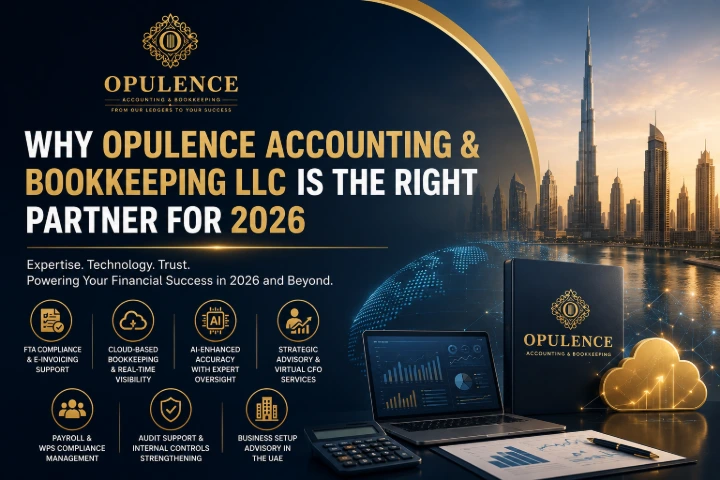
Why Opulence Accounting & Bookkeeping LLC is the Right Partner for 2026
Opulence Accounting & Bookkeeping LLC is a trusted accounting firm in Dubai delivering professional accounting, bookkeeping, VAT, corporate tax, and financial advisory services to SMEs, startups, and enterprises across the UAE and GCC.
In 2026, Opulence combines experienced financial professionals with technology-driven processes to deliver:
- Full FTA compliance support including VAT return filing, corporate tax registration, and e-invoicing readiness
- Cloud-based bookkeeping with real-time financial visibility
- AI-enhanced accuracy with expert human oversight on every compliance decision
- Strategic financial advisory and Virtual CFO services for growing businesses
- Dedicated payroll management and WPS compliance processing
- Audit support and internal controls strengthening
- Business setup advisory for companies launching or restructuring in the UAE
Whether you are a startup building your financial foundation or an established business preparing for your next phase of growth, Opulence delivers the expertise, technology, and dedication your business deserves.
Frequently Asked Questions (FAQ)
Q1. What is e-invoicing in the UAE and is it mandatory in 2026?
E-invoicing refers to the digital transmission of invoice data directly to the FTA portal in real time. The UAE is progressively rolling out e-invoicing requirements as part of its digital tax infrastructure. Businesses should be preparing now — both technically and operationally — to ensure compliance as mandates extend across sectors.
Q2. How is AI changing accounting for UAE businesses in 2026?
AI is automating core bookkeeping tasks including transaction categorization, bank reconciliation, invoice processing, and VAT classification. It also enables predictive cash flow forecasting and automated corporate tax provisions. The most effective model combines AI efficiency with expert human oversight — which is exactly how Opulence structures its services.
Q3. Does UAE Corporate Tax apply to free zone companies?
Free zone businesses may benefit from a 0% Corporate Tax rate on qualifying income. However, the distinction between qualifying and non-qualifying income is complex and depends on the nature of activities, customers, and compliance with Qualifying Free Zone Person requirements. Professional corporate tax advice is essential to protect your free zone tax position.
Q4. What is the Domestic Minimum Top-up Tax (DMTT) in the UAE?
The DMTT is a UAE implementation of the OECD Pillar Two global minimum tax rules. It applies to large multinational groups with global revenues exceeding EUR 750 million, ensuring they pay a minimum effective tax rate of 15% in the UAE. Businesses affected need to assess their structures and prepare consolidated reporting accordingly.
Q5. How does cloud accounting help with FTA compliance in 2026?
Cloud accounting platforms integrate directly with FTA systems, enabling real-time VAT liability tracking, automated VAT return preparation, and seamless e-invoice submission. This eliminates the reconciliation gaps that cause compliance issues under manual or desktop-based systems.
Q6. What UAE businesses benefit most from a Virtual CFO?
Startups preparing for funding rounds, SMEs scaling across multiple emirates or GCC markets, and businesses navigating complex transactions such as M&A, restructuring, or new product launches benefit most from Virtual CFO services. It provides CFO-level financial leadership at a fraction of the cost of a full-time hire.
Q7. How do I know if my accounting records are corporate tax compliant?
Article 56 of UAE Federal Decree-Law No. 47 requires businesses to maintain financial records for a minimum of seven years. Records must be IFRS-compliant, include proper VAT treatment, support transfer pricing positions, and align with payroll and WPS records. Opulence offers compliance reviews that assess your current records and identify any gaps before FTA scrutiny.
Q8. How do I get started with Opulence Accounting?
Contact Opulence via WhatsApp or the website enquiry form to book a free consultation. The team will review your current financial setup and recommend a tailored solution covering bookkeeping, tax compliance, payroll, and advisory support — all under one trusted partnership.
2026 Is the Year to Future-Proof Your UAE Business Finances
The financial compliance landscape in the UAE has never been more dynamic — or more demanding. E-invoicing, AI automation, tightening corporate tax enforcement, and real-time FTA integration are reshaping what it means to manage a financially healthy, compliant business in 2026.
The businesses that will thrive are those that stop treating accounting as a back-office function and start treating it as a strategic priority. The right professional partner does not just keep your books — they protect your compliance, optimize your tax position, and give you the financial clarity to make better decisions faster.
Ready to future-proof your business finances? Talk to Opulence Accounting today.