The introduction of Corporate Tax in the UAE has reshaped the country's tax landscape while reinforcing its reputation as a globally competitive business destination. As businesses adapt to the evolving regulatory environment, understanding corporate tax obligations is essential to remain compliant and avoid costly penalties.
Whether you operate a mainland company, a free zone entity, or a foreign business with operations in the UAE, staying informed about the latest Corporate Tax regulations will help you make better financial decisions and maintain regulatory compliance.
At Opulence Accounting & Bookkeeping LLC, we provide expert Corporate Tax advisory, registration, accounting, bookkeeping, and tax compliance services to businesses across the UAE.
What is Corporate Tax in the UAE?
Corporate Tax is a federal tax imposed on the taxable profits of businesses operating in the UAE under Federal Decree-Law No. 47 of 2022. Introduced for financial years beginning on or after 1 June 2023, the tax supports international tax transparency while preserving the UAE's attractive business environment.
Corporate Tax generally applies to:
- Mainland companies
- Free Zone companies
- Foreign entities with taxable operations in the UAE
- Individuals carrying on business activities that meet the applicable threshold
Businesses engaged in the extraction of natural resources continue to be taxed under Emirate-level legislation.
UAE Corporate Tax Rates for 2026
The UAE follows a straightforward corporate tax structure designed to encourage business growth.
0% Corporate Tax
Applies to taxable income up to AED 375,000.
9% Corporate Tax
Applies to taxable income exceeding AED 375,000.
15% Domestic Minimum Top-Up Tax
Large multinational enterprise groups meeting the OECD Pillar Two requirements may be subject to a 15% Domestic Minimum Top-Up Tax (DMTT) from 1 January 2025.
Who Must Register for Corporate Tax?
Businesses and individuals conducting taxable business activities in the UAE are generally required to register.
This includes:
- UAE mainland companies
- Free Zone entities
- Foreign companies with a Permanent Establishment (PE)
- Companies effectively managed and controlled in the UAE
- Natural persons carrying on business with annual turnover exceeding AED 1 million
Even businesses with little or no taxable income may still have registration and filing obligations.
How Corporate Tax is Calculated
Corporate Tax is calculated based on taxable profits rather than total revenue.
The general calculation process includes:
- Determine accounting profit from financial statements.
- Adjust profits for allowable deductions and exempt income.
- Apply tax adjustments required under UAE Corporate Tax Law.
- Calculate taxable income.
- Apply the appropriate Corporate Tax rate.
Maintaining accurate accounting records is essential to ensure proper tax calculations and compliance.
Businesses Exempt from Corporate Tax
Certain entities may qualify for exemptions under UAE Corporate Tax legislation.
Examples include:
- Government entities
- Government-controlled entities
- Qualifying public benefit organisations
- Eligible investment funds
- Public and private pension funds
- Certain natural resource businesses
- Qualifying government-owned subsidiaries
Eligibility depends on meeting the conditions established by the Ministry of Finance and the Federal Tax Authority.
Small Business Relief
To support startups and SMEs, the UAE provides Small Business Relief (SBR).
Eligible resident businesses may qualify if:
- Annual revenue does not exceed AED 3 million
- The required election is made when filing the Corporate Tax Return
- FTA eligibility requirements are satisfied
The relief is currently available until 31 December 2026.
Corporate Tax Registration Process
Businesses required to register should complete their registration through the EmaraTax portal.
Typical documentation includes:
- Trade Licence
- Certificate of Incorporation
- Memorandum of Association
- Emirates ID and Passport of owners or authorised signatories
- Ownership information
- Authorisation documents where applicable
Early registration helps businesses avoid administrative penalties.
Corporate Tax Return Filing
Every registered taxable person must submit an annual Corporate Tax Return.
Generally, businesses must:
- File the Corporate Tax Return
- Pay any Corporate Tax due
within nine months after the end of the financial year.
For example, if your financial year ends on 31 December 2025, the filing and payment deadline is generally 30 September 2026.
Corporate Tax Compliance Requirements
Effective Corporate Tax compliance requires more than submitting a tax return.
Businesses should:
- Register within the prescribed deadline
- Maintain complete accounting records
- Prepare financial statements
- Retain supporting documentation for at least seven years
- Maintain transfer pricing documentation where applicable
- Monitor related-party transactions
- Keep accounting records updated throughout the year
Good bookkeeping significantly simplifies Corporate Tax compliance.
Common Corporate Tax Penalties
Failure to comply with UAE Corporate Tax regulations may result in administrative penalties.
Common compliance failures include:
- Late Corporate Tax registration
- Late filing of Corporate Tax Returns
- Late payment of Corporate Tax
- Incorrect tax information
- Failure to maintain proper accounting records
Businesses should establish robust accounting systems to reduce compliance risks.
Corporate Tax for Free Zone Companies
Free Zone companies remain within the UAE Corporate Tax regime.
A Qualifying Free Zone Person (QFZP) may continue to benefit from a 0% Corporate Tax rate on qualifying income, provided all eligibility requirements are satisfied.
Income that does not qualify may be subject to the standard Corporate Tax rate.
Professional guidance is recommended to correctly classify qualifying and non-qualifying income.
Why Professional Corporate Tax Support Matters
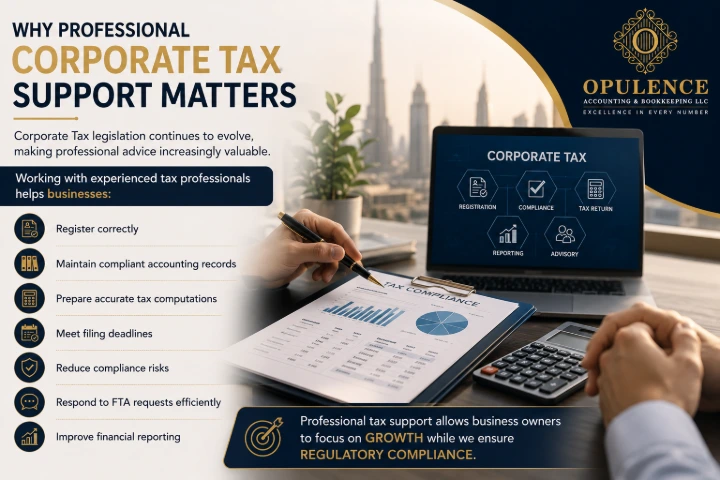
Corporate Tax legislation continues to evolve, making professional advice increasingly valuable.
Working with experienced tax professionals helps businesses:
- Register correctly
- Maintain compliant accounting records
- Prepare accurate tax computations
- Meet filing deadlines
- Reduce compliance risks
- Respond to FTA requests efficiently
- Improve financial reporting
Professional tax support also allows business owners to focus on growth while ensuring regulatory compliance.
Why Choose Opulence Accounting & Bookkeeping LLC?
At Opulence Accounting & Bookkeeping LLC, we deliver comprehensive Corporate Tax solutions tailored to businesses across the UAE.
Our services include:
- Corporate Tax Registration
- Corporate Tax Return Filing
- Corporate Tax Advisory
- Accounting & Bookkeeping
- VAT Registration & Return Filing
- Financial Statement Preparation
- Tax Compliance Reviews
- Transfer Pricing Support
- Audit Assistance
- CFO & Financial Advisory Services
Our experienced professionals help businesses stay compliant, reduce tax risks, and build long-term financial stability.
Stay Compliant with UAE Corporate Tax in 2026
Corporate Tax compliance is now a fundamental part of doing business in the UAE. Businesses that maintain accurate financial records, understand their obligations, and seek professional guidance are better positioned to avoid penalties and operate with confidence.
Whether you're launching a new company, managing an established business, or expanding into the UAE, Opulence Accounting & Bookkeeping LLC is your trusted partner for Corporate Tax registration, compliance, accounting, and financial advisory services.
Contact Opulence today to ensure your business remains fully compliant with the latest UAE Corporate Tax regulations.
Frequently Asked Questions
Is Corporate Tax mandatory in the UAE?
Most businesses operating in the UAE are required to assess their Corporate Tax obligations and comply with FTA regulations.
What is the Corporate Tax rate in the UAE?
The standard rates are 0% on taxable income up to AED 375,000 and 9% on taxable income exceeding AED 375,000, subject to applicable rules.
When is the Corporate Tax filing deadline?
Corporate Tax Returns are generally due within nine months after the end of the financial year.
Do Free Zone companies pay Corporate Tax?
Free Zone companies fall within the Corporate Tax regime. Qualifying Free Zone Persons may benefit from a 0% rate on qualifying income if they meet the prescribed conditions.
How can Opulence help with Corporate Tax?
Opulence offers end-to-end Corporate Tax services, including registration, advisory, accounting, bookkeeping, return filing, compliance reviews, VAT services, and ongoing financial support for businesses throughout the UAE.
Ensure Your UAE Corporate Tax Compliance with Confidence
Corporate Tax compliance doesn't have to be complicated. Whether you need assistance with Corporate Tax Registration, Corporate Tax Return Filing, Accounting & Bookkeeping, VAT Compliance, or ongoing financial advisory, the experts at Opulence Accounting & Bookkeeping LLC are here to help.
Our experienced tax professionals provide tailored solutions to keep your business fully compliant with the latest UAE Corporate Tax regulations while minimizing risks and improving financial efficiency.
📞 Get in touch with Opulence today for a personalized Corporate Tax consultation and let us help your business stay compliant, avoid penalties, and achieve long-term financial success in the UAE.