If you are running an SME in the UAE, understanding Internal vs External Audit UAE requirements is no longer optional. With increasing regulatory scrutiny, corporate tax implementation, and financial transparency demands, business owners must know which audit type is essential for compliance — and which one protects profitability.
Many UAE business owners ask:
- Is external audit mandatory in the UAE?
- Do SMEs need internal audits?
- What is the difference between internal and external audits?
- Which audit adds more value to my business?
This guide answers these questions clearly and helps you decide what your business actually needs.
What Is an External Audit in the UAE?
An external audit is an independent examination of your company’s financial statements conducted by a licensed third-party audit firm.
Purpose of External Audit
- Ensure compliance with UAE laws and regulations
- Verify financial statement accuracy
- Provide credibility to banks, investors, and authorities
- Support corporate tax and VAT compliance
In many UAE Free Zones and Mainland structures, annual external audits are mandatory.
Who Requires External Audits in the UAE?
- Free Zone companies (as per authority regulations)
- Businesses undergoing mergers or acquisitions
- Companies applying for bank facilities
- Entities subject to statutory requirements
Example:
A Dubai Free Zone company renewing its trade license may need audited financial statements as part of regulatory compliance.

What Is an Internal Audit?
An internal audit is a proactive, ongoing evaluation of your company’s internal controls, financial systems, operational efficiency, and risk management processes.
Unlike external audits, internal audits are not always mandatory — but they are strategic.
Purpose of Internal Audit
- Identify financial leakages
- Strengthen internal controls
- Detect fraud or inefficiencies
- Improve operational performance
- Optimize cost structures
Internal audits are usually conducted periodically — quarterly or annually — depending on business size and complexity.
Example:
An SME in Abu Dhabi discovers through an internal audit that inventory mismanagement is causing a 12% annual loss. Corrective controls improve profit margins immediately.

Internal vs External Audit UAE: Key Differences Explained
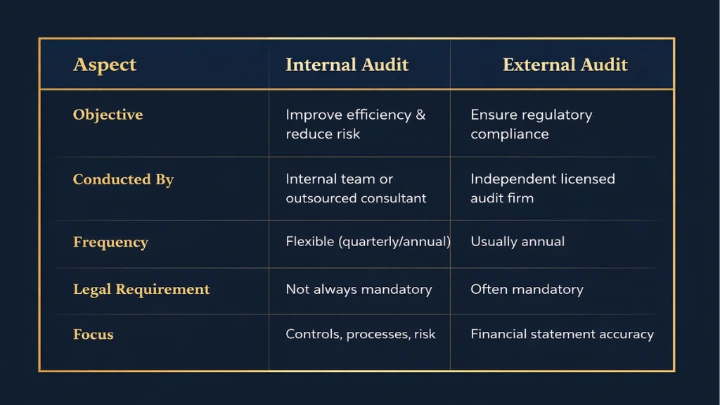
When Does Your UAE Business Need an External Audit?
You likely need an external audit if:
- Your Free Zone authority requires it
- You are applying for business loans
- You are filing corporate tax returns
- Investors demand financial transparency
- You are preparing for acquisition or restructuring
External audits provide legal and financial assurance.
Failure to comply may result in:
- Trade license renewal delays
- Regulatory penalties
- Loss of investor trust
When Should SMEs Consider an Internal Audit?
Even if not legally required, internal audits are highly recommended when:
- Revenue is growing rapidly
- Corporate tax exposure increases
- You suspect financial inefficiencies
- You lack segregation of duties
- Cash flow issues persist
Signs You Need an Internal Audit Immediately
- Frequent accounting errors
- Unexplained expense increases
- Delayed financial reporting
- Weak documentation processes
Internal audits act as a preventive control mechanism, especially important in the UAE’s evolving regulatory landscape.
Corporate Tax & Audit Strategy in the UAE
With the introduction of UAE Corporate Tax, businesses must maintain accurate financial records.
An effective strategy often includes:
- External audit for statutory compliance
- Internal audit for tax risk mitigation
- Periodic financial health checks
Combining both strengthens governance and reduces exposure to tax penalties.
Common Misconceptions About Internal vs External Audit UAE
“External audit will catch internal fraud.”
Not necessarily. External audits test samples and focus on financial statement accuracy — not operational efficiency.
“Internal audits are expensive.”
In reality, internal audits often recover more money than they cost by identifying inefficiencies.
“Small businesses don’t need internal audits.”
Smaller businesses are actually more vulnerable to control weaknesses.
How Opulence Accounting and Bookkeeping LLC Supports UAE Businesses
At Opulence Accounting and Bookkeeping LLC, we provide comprehensive audit services across the UAE, including:
- Statutory external audits
- Internal audit services
- Corporate tax advisory support
- Risk assessment and compliance reviews
- Financial health check analysis
Our approach is practical and business-focused. We don’t just verify numbers — we help strengthen systems.
Whether you operate in Dubai, Abu Dhabi, Sharjah, or any UAE Free Zone, we ensure your audit process is seamless, compliant, and value-driven.
Practical Steps to Decide What Your Business Needs
Review your trade license and Free Zone regulations
Assess your corporate tax exposure
Evaluate financial control weaknesses
Consider growth plans and investor expectations
Consult a qualified audit firm
An audit is not just a regulatory formality — it is a strategic tool.
Why Understanding Internal vs External Audit UAE Matters for Your Business
Understanding the difference between Internal vs External Audit UAE is essential for every SME aiming for stability and growth. An external audit ensures regulatory compliance, strengthens credibility, and helps you meet statutory requirements. An internal audit, on the other hand, focuses on protecting your profitability by improving controls, identifying inefficiencies, and reducing financial risk. For businesses seeking long-term, sustainable growth in the UAE, implementing both can provide a strong balance between compliance and operational excellence. Neglecting a proper audit strategy may lead to penalties, tax exposure, or unnecessary financial losses in the future.
Learn more about Internal audit Learn more about External audit
Take the Next Step
If you are unsure which audit your UAE business requires, let professionals guide you.
