Many businesses assume that tax management simply means submitting tax returns on time. While tax filing is mandatory for regulatory compliance, tax planning is a strategic process that helps businesses legally reduce tax liabilities and improve financial efficiency. With the introduction of corporate tax regulations, understanding the difference between tax planning and filing has become increasingly important for companies operating in the UAE.
Professional Corporate Tax UAE advisory services help businesses structure their finances in a tax-efficient way while ensuring compliance with regulatory requirements. By combining accurate tax filing with strategic tax planning, companies can improve profitability, avoid penalties, and maintain financial stability.
Understanding Tax Filing in the UAE
Tax filing is the process of submitting tax returns and financial information to comply with government regulations. It is a mandatory obligation for businesses operating under the UAE corporate tax framework.
Key Responsibilities in Tax Filing
Businesses are required to:
Submit corporate tax returns within the specified deadlines
Maintain proper financial records and documentation
Ensure accuracy in income, expenses, and tax calculations
Comply with UAE tax regulations
Failure to meet tax filing requirements may result in penalties, fines, or legal complications.
Why Tax Filing Alone Is Not Enough
While filing ensures regulatory compliance, it does not necessarily optimize the tax position of a business. Companies that only focus on filing may end up paying higher taxes due to inefficient financial structures.

What Is Strategic Tax Planning?
Tax planning involves analyzing financial activities and structuring business operations in a way that legally minimizes tax liabilities while remaining fully compliant with regulations.
Strategic tax planning focuses on:
Optimizing business structures
Managing deductible expenses
Improving financial efficiency
Preparing for long-term tax obligations
Professional Corporate Tax UAE advisors help businesses identify opportunities to legally reduce tax burdens while maintaining transparency with authorities.
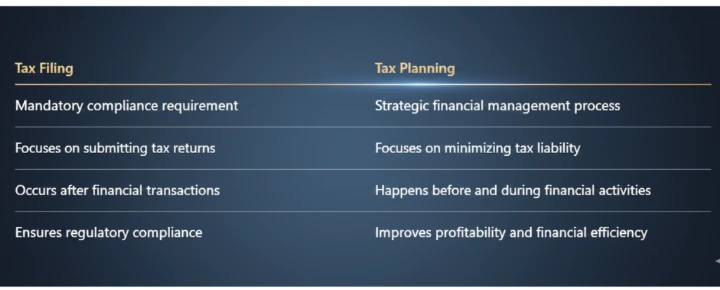
Key Differences Between Tax Planning and Tax Filing
Understanding how these two processes differ helps businesses manage taxes more effectively.
Both processes are essential for businesses, but tax planning provides the strategic advantage.
Why Tax Planning Matters for Businesses in the UAE

With the implementation of corporate tax regulations, companies must manage their finances carefully to maintain profitability.
Strategic tax planning helps businesses:
Reduce unnecessary tax expenses
Improve financial forecasting
Align business operations with tax regulations
Prevent compliance risks
Common Tax Planning Strategies for Businesses
Professional tax advisors use various strategies to ensure tax efficiency while maintaining compliance.
Optimizing Business Structure
The structure of a company significantly impacts its tax obligations. Proper structuring ensures businesses benefit from applicable tax regulations.
Managing Deductible Expenses
Many operational expenses are eligible for tax deductions. Identifying and documenting these expenses correctly can reduce taxable income.
Accurate Financial Documentation
Maintaining organized financial records allows businesses to justify deductions and comply with regulatory requirements.
Long-Term Financial Planning
Tax planning is not a one-time process. Businesses must continuously analyze financial performance and adjust strategies to remain efficient.
Challenges Businesses Face Without Professional Tax Advisory
Many SMEs struggle with tax management due to:
Limited understanding of corporate tax regulations
Improper financial documentation
Missed tax-saving opportunities
Increased risk of compliance errors
Professional Corporate Tax UAE advisory services help businesses navigate these complexities and maintain regulatory compliance.
The Role of Corporate Tax Advisors
Tax advisors play a critical role in helping businesses align financial strategies with regulatory requirements.
Their services typically include:
Corporate tax compliance support
Tax planning strategies
Financial structure optimization
Risk assessment and compliance guidance
Working with experienced tax professionals allows businesses to manage taxes efficiently while focusing on growth.

Why Strategic Tax Planning Is Essential for Business Growth
Businesses that only focus on tax filing often miss opportunities to improve profitability. Strategic tax planning ensures that financial decisions are made with long-term efficiency in mind.
When companies integrate planning with compliance, they benefit from:
Reduced tax burdens
Better financial management
Stronger regulatory compliance
Improved long-term profitability
Professional tax advisory ensures that businesses operate efficiently while staying aligned with UAE tax laws.
Get Expert Corporate Tax Guidance
If you want to improve tax efficiency and maintain compliance with UAE regulations, professional tax advisory can make a significant difference.
At Opulence Accounting & Bookkeeping LLC, we provide expert Corporate Tax UAE advisory services designed to help businesses structure their finances strategically while meeting regulatory requirements.
Book a tax planning session today and discover how strategic tax planning can improve your business profitability.