UAE Small Business Relief lets resident businesses with revenue up to AED 3 million elect zero corporate tax. It applies only to tax periods ending on or before 31 December 2026, and no extension has been announced. From 2027, all businesses move to the standard regime: 0% on the first AED 375,000 of taxable income and 9% above that, regardless of revenue size.
A Grace Period That Is Genuinely Ending
When the UAE introduced federal corporate tax under Federal Decree-Law No. 47 of 2022, Small Business Relief (SBR) was built in as a bridge, not a permanent feature. It let qualifying SMEs, freelancers, and startups operate largely tax-free while the wider business community adjusted to the new regime.
That bridge closes on 31 December 2026. From 1 January 2027, the standard corporate tax rules apply to every UAE business, regardless of whether it previously elected SBR. For a great many small and mid-sized businesses that have paid nothing in corporate tax since 2023, this will be the first real tax bill they have ever faced.
Who Qualifies for Small Business Relief?
Small Business Relief is available to UAE-resident businesses whose revenue does not exceed AED 3 million in the relevant and prior tax periods. A few points are frequently misunderstood:
• It is an election, not automatic. You must actively choose SBR when filing your corporate tax return on EmaraTax — silence does not grant it.
• It is assessed period by period. Qualifying this year does not carry the relief forward; you must elect it again for each eligible tax period.
• It has a trade-off. Electing SBR means forfeiting any tax losses or disallowed interest relief for that period, so it is worth checking whether it is genuinely the better outcome for your business.
• Registration is still mandatory. Even if your revenue keeps you under the threshold, you must register for corporate tax with the FTA. Being under the threshold is not a reason to skip registration, and late registration penalties start at AED 10,000.
Small Business Relief vs. the Standard Regime
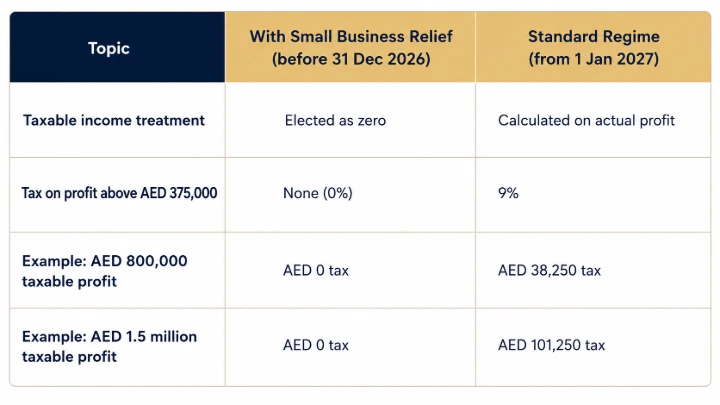
The AED 375,000 zero-tax band is permanent and applies to every UAE business regardless of revenue. Small Business Relief goes further, letting qualifying SMEs elect zero taxable income entirely — even on profits well above that threshold. Once SBR ends, that gap becomes a real annual cost for profitable SMEs:
What Dubai SMEs Should Do Before December 2026
• Confirm you're registered for corporate tax. If you haven't registered with the FTA yet, start now through EmaraTax — the process typically takes two to four weeks including follow-up queries.
• Elect Small Business Relief on your next return, if eligible. The election is made when filing, within the standard nine-month deadline after your tax period ends.
• Run the numbers before electing. Because SBR forfeits loss carry-forwards and disallowed interest relief, businesses with losses or complex financing may be better off under the standard regime.
• Build audit-ready bookkeeping now. From 2027, your financial records directly determine your taxable income and your tax bill. Informal or incomplete bookkeeping becomes a much bigger liability once real tax is at stake.
• Model your post-2026 tax position. Understanding what your business will owe under the standard 9% regime lets you plan cash flow well ahead of your first real filing, instead of reacting to it.
• Review your structure. Depending on your setup, options like Qualifying Free Zone Person (QFZP) status may be worth evaluating alongside the end of SBR.
Why This Deserves Attention Now, Not in 2027
The businesses that will feel the transition hardest are the ones that treat 2026 as business as usual. Corporate tax under the standard regime is calculated from your accounting income, adjusted per IFRS, which means the bookkeeping habits you build this year directly shape the tax bill you face next year. Waiting until the relief has already expired leaves far less room to plan, restructure, or simply get your records in order.
How Opulence Can Help
Opulence Accounting & Bookkeeping LLC works with SMEs across Dubai and the wider UAE to confirm corporate tax registration, assess Small Business Relief eligibility, and build the accounting foundation needed for the standard regime from 2027. Whether you are electing SBR for the first time or preparing your business for its first full corporate tax filing, our team can guide the transition before the deadline arrives.
Frequently Asked Questions
1. When does UAE Small Business Relief expire?
Small Business Relief applies only to tax periods ending on or before 31 December 2026. No extension has been announced, so from 2027 the standard corporate tax regime applies to all businesses.
2. Who is eligible for Small Business Relief?
UAE-resident businesses with revenue not exceeding AED 3 million in the relevant and prior tax periods can elect Small Business Relief, subject to meeting the other conditions under Article 21 of Federal Decree-Law No. 47 of 2022.
3. Is Small Business Relief applied automatically?
No. It must be actively elected when filing your corporate tax return on EmaraTax. If you don't make the election, standard corporate tax rules apply by default.
4. Do I still need to register for corporate tax if my revenue is under AED 3 million?
Yes. Corporate tax registration is mandatory for all UAE businesses regardless of revenue. Being under the Small Business Relief threshold does not exempt you from registering, and late registration penalties start at AED 10,000.
5. What happens after Small Business Relief ends?
From 1 January 2027, all businesses fall under the standard regime: 0% corporate tax on the first AED 375,000 of taxable income, and 9% on taxable income above that, regardless of total revenue.
6. Should every eligible SME elect Small Business Relief?
Not necessarily. Electing SBR means forfeiting tax losses and disallowed interest relief for that period, so businesses with losses or significant financing costs should run the comparison before electing.
7. What is the filing deadline to elect Small Business Relief?
The election is made when filing your corporate tax return, within the standard nine-month deadline after the end of your tax period.
8. How long do I need to keep records after electing Small Business Relief?
The FTA requires supporting records to be retained for seven years after the relevant tax period, even where zero tax was paid.
9. Is the AED 375,000 zero-tax threshold also ending?
No. The AED 375,000 zero-tax band is a permanent feature of UAE corporate tax and applies to every business regardless of revenue. Only Small Business Relief, which allows zero tax on higher profits, is expiring.
10. What should my business be doing right now?
Confirm your corporate tax registration is complete, elect Small Business Relief on eligible returns before the deadline, and use the remaining months to build accounting records that will support your first standard-regime filing from 2027.
Plan Your Transition Before the Deadline
Opulence Accounting & Bookkeeping LLC helps Dubai
SMEs confirm eligibility, file correctly, and prepare their books for the
standard corporate tax regime from 2027.