There is a quiet but urgent deadline approaching for thousands of UAE businesses — and most are completely unaware of it.
Under Federal Decree-Law No. 16 of 2025, which amended the UAE VAT Law effective 1 January 2026, a strict five-year limitation period now governs when businesses can reclaim excess refundable VAT or apply credit balances against outstanding liabilities.
In plain terms: if your business has a VAT credit balance on its FTA EmaraTax portal that dates back to 2020 or earlier, you have until 31 December 2026 to claim it. After that transitional deadline, those funds are permanently forfeited. The FTA is under no legal obligation to return them.
At Opulence Accounting and Bookkeeping LLC, a leading provider of VAT services in UAE, we are already helping businesses identify dormant credit balances they did not know existed. This blog explains everything you need to know — and exactly what to do before time runs out.
The New 5-Year VAT Refund Limitation Explained
The five-year limitation is introduced under Federal Decree-Law No. 16 of 2025 amending Federal Decree-Law No. 8 of 2017 on Value Added Tax. Two concurrent rules now apply from 1 January 2026.
For Taxpayers
You must submit a refund request or apply any excess VAT credit balance against outstanding tax liabilities within five years from the end of the tax period in which the credit arose. Once this five-year window closes, your legal right to that money expires permanently.
For the FTA
The Federal Tax Authority must apply any taxpayer credit or overpayment against outstanding obligations within the same five-year period. This creates regulatory symmetry but also a hard, non-negotiable boundary.
The Critical Transitional Window — 31 December 2026
Because UAE VAT only began in January 2018, credit balances from tax periods in 2018, 2019, and 2020 would instantly fall outside the five-year window under the new law. To address this, the legislation grants a transitional year — until 31 December 2026 — for businesses to submit refund applications for these historic balances. After this date, the right to claim any pre-2021 excess VAT credit is permanently extinguished. This is a hard legal deadline, not a guideline.
Why Do UAE Businesses Have Dormant VAT Credit Balances?
VAT credit balances arise when a business's input VAT (VAT paid on purchases and expenses) exceeds its output VAT (VAT collected on sales) in a given tax period. This is common across many business types in the UAE.
Common Causes
- Zero-rated export businesses: companies exporting goods or services internationally charge 0% VAT on sales but pay 5% VAT on local purchases, regularly generating credit balances.
- Capital-intensive start-up phases: significant capital expenditure during setup — equipment, fit-outs, machinery — creates high input VAT before sufficient sales revenue is generated.
- Real estate and construction: developers and contractors often carry credit balances due to timing mismatches between paying VAT on materials and collecting it on completed projects.
- COVID-19 disruption (2020): many businesses had strong input VAT from pre-pandemic purchases but collapsed output VAT from reduced revenues. These balances have been sitting unresolved for years.
- Missed refund applications: many SMEs, particularly those without professional accounting support, never applied for VAT refunds and are unaware of balances sitting in their FTA accounts.
How to Check Your FTA VAT Credit Balance
Step-by-Step Process
- Log into the FTA EmaraTax portal at emaratax.gov.ae using your registered credentials.
- Navigate to your VAT return dashboard and review your complete filing history.
- Check for any excess credit balance shown against completed tax periods.
- Identify the specific tax periods in which each credit arose.
- Flag any credits from tax periods ending on or before 31 December 2020 as urgent.
- Engage a qualified VAT consultant in Dubai immediately to review the balance, verify underlying transactions, and prepare a clean refund application.
Do not wait until late 2026. FTA VAT refund processing requires supporting documentation — invoices, contracts, bank statements — and can take several months, Starting early is essential.
Other Important VAT Compliance Changes in 2026
Reverse Charge Mechanism — Self-Invoicing Abolished
From 1 January 2026, businesses importing goods or services for business use are no longer required to issue a self-invoice for Reverse Charge Mechanism transactions. This simplifies paperwork but shifts the compliance burden to retaining source documents: original supplier invoices, contracts, purchase orders, delivery confirmations, and payment evidence. The FTA will rely on these documents in place of self-invoices during audits.
Stricter Input VAT Denial — The 'Should Have Known' Principle
The FTA now has explicit authority to deny input VAT deductions where a supply was connected to tax evasion and the recipient knew or should have known about the fraudulent intent. This means Know Your Vendor due diligence is not just best practice — it is a legal safeguard protecting your input VAT claims. Structured bookkeeping services in UAE that maintain clean supplier records have never been more important.
Extended Record Retention in Specific Cases
The record retention period has been extended by two years in cases where a refund claim was submitted before the statute of limitations expired but the FTA has not yet issued a determination. This gives businesses additional time to maintain records for active refund claims under review.
VAT Compliance Checklist for UAE Businesses in 2026
- Check FTA EmaraTax portal for all credit or overpayment balances now.
- Identify the originating tax period for every credit balance.
- Flag all credits from periods ending before 31 December 2020 as requiring urgent action.
- Engage a VAT consultant to prepare and submit refund applications for pre-2021 credits before 31 December 2026.
- Update internal RCM processes to eliminate self-invoicing and strengthen source document retention.
- Implement Know Your Vendor due diligence procedures for all suppliers.
- Ensure all source documents for reverse charge transactions are centrally archived and accessible.
- Confirm your VAT return filing is current with no missed quarterly periods.
- Review any voluntary disclosure obligations for historical filing errors.
How Opulence Accounting Supports Your VAT Compliance
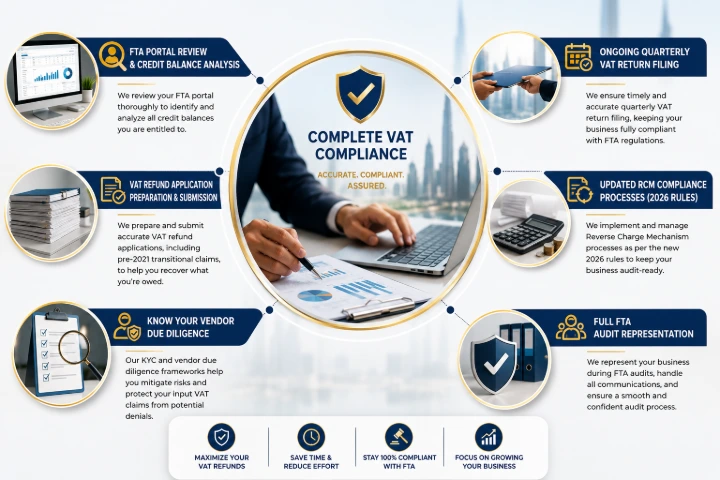
Opulence Accounting and Bookkeeping LLC is a trusted accounting firm in Dubai providing comprehensive VAT services in UAE. Our team offers FTA portal review and credit balance analysis to identify everything you are owed, VAT refund application preparation and submission including pre-2021 transitional claims, ongoing quarterly VAT return filing with complete accuracy, updated RCM compliance processes reflecting the new 2026 rules, Know Your Vendor due diligence frameworks to protect your input VAT claims, and full FTA audit representation.
Don’t Let Your VAT Refund Expire — Act Before the 31 December 2026 Deadline
Hidden VAT credit balances could already be sitting in your FTA EmaraTax account. Once the new five-year limitation period takes effect, unclaimed balances may be lost permanently.
Opulence Accounting and Bookkeeping LLC helps UAE businesses identify dormant VAT credits, prepare compliant refund applications, and ensure complete FTA compliance before the deadline expires.
Frequently Asked Questions
Q1. What is the UAE VAT refund deadline for pre-2021 credit balances?
Under the transitional provisions of Federal Decree-Law No. 16 of 2025, businesses must claim VAT credit balances from tax periods ending on or before 31 December 2020 by 31 December 2026. After this date, the right to those refunds expires permanently under the new five-year limitation rule. Act immediately — do not wait until late 2026 as processing takes time.
Q2. How do I find out if I have a VAT credit balance with the FTA?
Log into the FTA EmaraTax portal at emaratax.gov.ae and review your VAT return history. Any excess input VAT from previous periods should appear as a credit balance on your account. A professional VAT consultant in Dubai can review this on your behalf, verify the supporting documentation, and advise on the most effective recovery strategy.
Q3. What happens if I miss the 31 December 2026 VAT refund deadline?
If you fail to submit a refund application for pre-2021 VAT credit balances before 31 December 2026, those funds are permanently forfeited. The FTA has no legal obligation to return them after the transitional window closes. For businesses with significant credit balances, this represents a material, irreversible financial loss.
Q4. Do I still need to issue a self-invoice for reverse charge VAT transactions?
No. From 1 January 2026, the requirement to issue a self-invoice for reverse charge transactions has been removed under Federal Decree-Law No. 16 of 2025. Instead, you must retain the original supplier invoice and all supporting documentation — contracts, purchase orders, delivery confirmations, and payment evidence — as the FTA will rely on these documents during any future audit.
Q5. Can the FTA deny my input VAT claim under the new 2026 rules?
Yes. The amended VAT Law explicitly empowers the FTA to deny input VAT deductions linked to transactions with suppliers involved in abusive tax schemes, if the recipient knew or should have known about the fraud. To protect your claims, strengthen your supplier due diligence processes and verify supplier legitimacy before claiming input VAT on any transaction.
Q6. Is the 5-year VAT limitation only for old balances or does it apply going forward?
Both. The five-year limitation applies to historic balances — with the special transitional year ending 31 December 2026 for pre-2021 credits — and on a rolling basis going forward. From 1 January 2026, every new VAT credit balance you accumulate starts a five-year clock from the end of that tax period. Businesses with structured VAT compliance processes will never be caught by this rule.
Q7. How can Opulence Accounting help with VAT refund claims and compliance?
Opulence Accounting and Bookkeeping LLC provides end-to-end VAT services in UAE including FTA portal reviews, refund claim preparation and submission, quarterly VAT return filing, updated RCM compliance processes, supplier due diligence frameworks, and FTA audit representation. We have helped businesses across Dubai, DIFC, Jebel Ali, and Abu Dhabi recover VAT credit balances they did not even know they were owed. Visit www.opulence.ae for a free consultation.