The era of relaxed tax enforcement in the UAE is over. According to the FTA's 2024 Annual Report and a February 2025 update, the Federal Tax Authority conducted 93,000 inspection visits in 2024 — a staggering 135% increase from the previous year — powered by advanced digital analytics and risk profiling tools.
With full corporate tax implementation underway, the e-invoicing mandate rolling out, and a completely reformed penalty framework active from April 2026, the FTA is operating with greater reach and precision than at any point in UAE tax history.
For UAE SMEs, the message is clear: an internal audit is no longer a box-ticking exercise reserved for large corporations. It is now a strategic business necessity. At Opulence Accounting and Bookkeeping LLC, a trusted audit firm in Dubai, we help businesses across the UAE build internal audit frameworks that are robust, efficient, and FTA-ready.
FTA Audit Risk Triggers for UAE Businesses
• Inconsistent VAT filings — mismatches between reported sales and purchase data across periods.
• Unusual VAT refund patterns — large or recurring refund claims that do not match industry norms.
• Corporate tax payments that appear low relative to reported revenue or industry benchmarks.
• Discrepancies between corporate tax returns and VAT filings — the FTA cross-references both.
• Related-party transactions without arm's length transfer pricing documentation.
• Free zone businesses claiming 0% Qualifying Free Zone Person status without adequate substance evidence.
• Poor or missing record keeping — missing invoices, unreconciled accounts, or incomplete financial records.
Businesses that tick multiple risk indicators face a significantly elevated probability of selection for a formal FTA audit. The cost of a post-audit penalty, interest, and back-tax assessment far exceeds the cost of proactive internal audit investment.
New 2026 Audit Requirements for Tax Groups
From tax periods beginning on or after 1 January 2025 — meaning filings due in 2026 — all tax groups in the UAE must prepare audited special-purpose financial statements. The previous AED 50 million revenue threshold for mandatory group audit has been eliminated entirely. Every tax group must now undergo a formal audit regardless of consolidated income size, with results submitted to the FTA within nine months of the financial year-end.
Separately, Qualifying Free Zone Persons must also undergo an independent external audit regardless of their income level. Audit firms in Dubai are already experiencing significant capacity constraints for the 2026 season. Businesses should engage their audit firm as early as possible.
What Internal Audit Actually Does for Your UAE Business
An effective internal audit function does far more than check whether your accounts add up. For UAE businesses operating under the 2026 compliance environment, internal audit provides protection, assurance, and strategic value across multiple dimensions.
1. FTA Audit Readiness
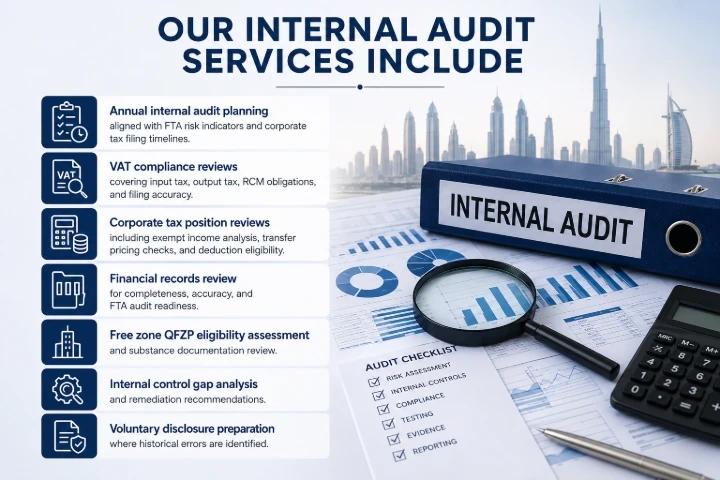
An internal audit reviews your financial records, VAT filings, corporate tax positions, transfer pricing documentation, and supporting evidence to identify gaps before the FTA does. Discovering an error internally allows you to correct it through a Voluntary Disclosure — at the new reduced 1% monthly penalty — rather than facing a post-audit assessment with the full 14% annual interest rate plus penalties.
2. Corporate Governance and Risk Management
UAE authorities, investors, and lenders increasingly expect businesses to demonstrate robust corporate governance. A structured internal audit function — with independent reporting to management or an audit committee — signals financial discipline and accountability. This directly supports banking relationships, investor confidence, and contract eligibility.
3. Transfer Pricing Compliance
Internal audit provides the regular review mechanism that ensures related-party transactions remain properly documented and arm's length priced throughout the financial year — not just at year-end when it may be too late to make adjustments without triggering an assessment.
4. Operational Efficiency and Cost Control
Internal audits consistently identify duplicate payments, unauthorised expenditure, inefficient procurement processes, and revenue leakage that businesses are not aware of. The return on investment from internal audit typically far exceeds its cost for any growing SME.
The FTA's Expanded Audit Powers in 2026
Federal Decree-Law No. 17 of 2025 expanded the FTA's audit authority significantly. Key changes that directly affect UAE businesses include stricter business-day deadlines for responding to FTA audit notices, broader powers to access third-party data including banking records, platform data, and government databases, explicit obligations on businesses to facilitate audits including providing records in specific formats and within defined timeframes, and extended periods for FTA to issue assessments in cases of deliberate non-disclosure.
Building an Internal Audit Framework for UAE SMEs
Opulence Accounting and Bookkeeping LLC provides customised internal audit and risk management services for SMEs across Dubai and the wider UAE. Our approach is practical, risk-focused, and built around the specific demands of the 2026 FTA compliance environment.
Businesses that have not maintained organised, audit-ready financial records now face a much more demanding environment when an FTA audit notice arrives.
Protect Your Business from Costly FTA Penalties
At Opulence Accounting and Bookkeeping LLC, we help UAE businesses stay compliant, reduce audit risks, and strengthen financial controls through expert internal audit and tax compliance solutions. Whether you need VAT reviews, corporate tax assessments, transfer pricing checks, or FTA audit readiness support, our team is ready to help your business navigate the evolving UAE tax landscape with confidence.
Frequently Asked Questions - FAQs
Q1. Is an internal audit mandatory for UAE SMEs in 2026?
A standalone internal audit function is not legally mandated for all SMEs. However, certain categories of businesses — all tax groups and Qualifying Free Zone Persons — are now required to prepare and submit audited financial statements under the 2026 corporate tax rules. Beyond mandatory requirements, an internal audit is strongly advisable for any UAE SME that has related-party transactions, carries VAT credit balances, operates in a high-risk sector, or has experienced rapid growth. Given the FTA's 135% increase in inspection visits in 2024, proactive internal audit is the most cost-effective risk management tool available.
Q2. How does the FTA select businesses for audit in 2026?
The FTA uses data analytics, risk profiling, and cross-referencing of corporate tax returns, VAT filings, and third-party data to identify high-risk businesses. Key audit triggers include inconsistent VAT filings, unusual refund patterns, low corporate tax payments relative to reported revenue, undocumented related-party transactions, and free zone businesses with questionable QFZP claims. The FTA's selection process is risk-based, not random, and is backed by ISO 31000 certified risk management infrastructure.
Q3. What is the difference between internal audit and external audit in the UAE?
An external audit is an independent examination of a company's financial statements by a licensed audit firm, resulting in an opinion on whether the statements are free from material misstatement. An external audit is required for certain entities — including Qualifying Free Zone Persons, tax groups, and businesses with revenue above AED 50 million. An internal audit, by contrast, is an ongoing review function focused on operational processes, financial controls, compliance posture, and risk management. Both are valuable and complementary; an effective internal audit function significantly reduces the risk and cost of an external audit.
Q4. What happens if the FTA finds errors during a corporate tax or VAT audit?
If the FTA identifies errors or understatements during an audit, it will issue a tax assessment covering the understated amount plus penalties and interest. Under the new 2026 penalty framework, interest on outstanding tax is charged at 14% per annum. Additional penalties may apply for deliberate non-disclosure. By comparison, proactively correcting errors through a Voluntary Disclosure before an audit carries only a 1% monthly penalty — making early detection through internal audit significantly less costly than post-audit correction.
Q5. Can an SME in a Dubai free zone be audited by the FTA?
Yes. Free zone companies are subject to FTA audit for both VAT and corporate tax. Qualifying Free Zone Persons that claim 0% corporate tax on qualifying income are specifically monitored for adequate economic substance, arm's length transfer pricing, qualifying income documentation, and annual audited financial statements. The FTA is increasingly focused on free zone compliance, and businesses that cannot support their 0% QFZP claim during audit face corporate tax exposure on all income plus penalties.
Q6. How much does internal audit cost for a Dubai SME?
Internal audit costs depend on business size, complexity, transaction volume, and the scope of the review. At Opulence Accounting and Bookkeeping LLC, we structure internal audit engagements to be practical and cost-effective for SMEs. The cost of a structured internal audit is invariably less than the cost of a single FTA penalty assessment. Contact us at www.opulence.ae for a tailored proposal.
Q7. How does Opulence Accounting approach internal audit for UAE businesses?
Our internal audit services in Dubai are structured around the specific risk environment of each client. We review VAT compliance, corporate tax positions, transfer pricing documentation, financial record integrity, and free zone QFZP eligibility. Where we identify errors, we prepare voluntary disclosures at the reduced penalty rate. Our goal is to ensure every client is FTA audit-ready at all times, with organised records, compliant filings, and a clear understanding of their tax exposure.